Category: 2010s
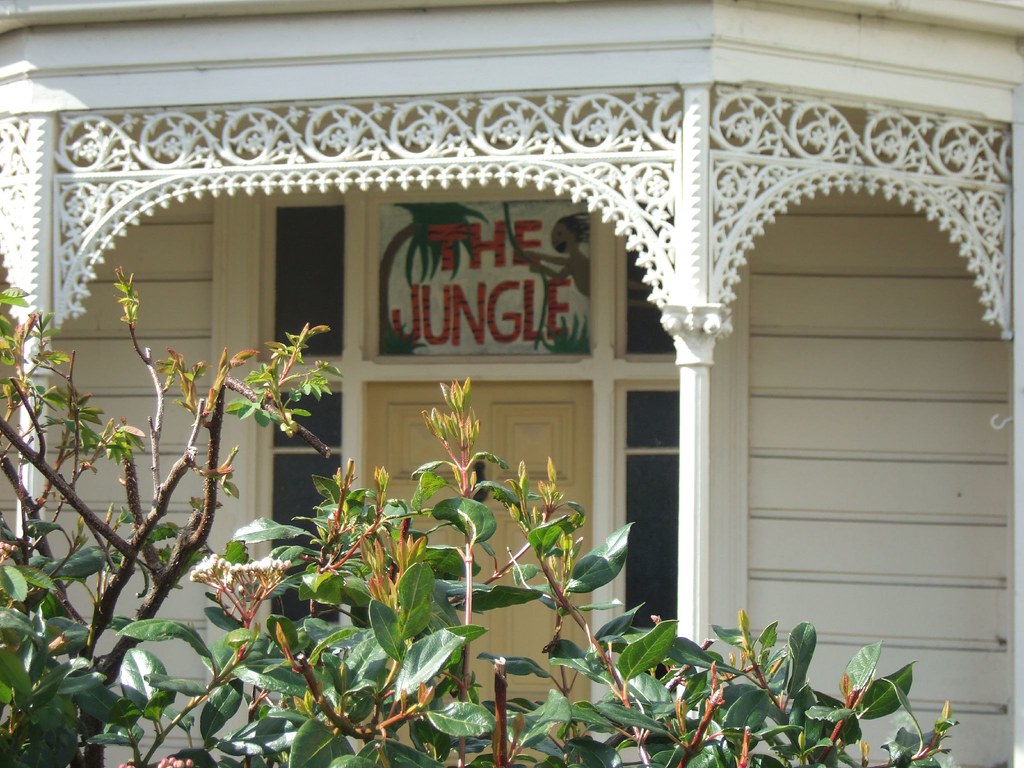
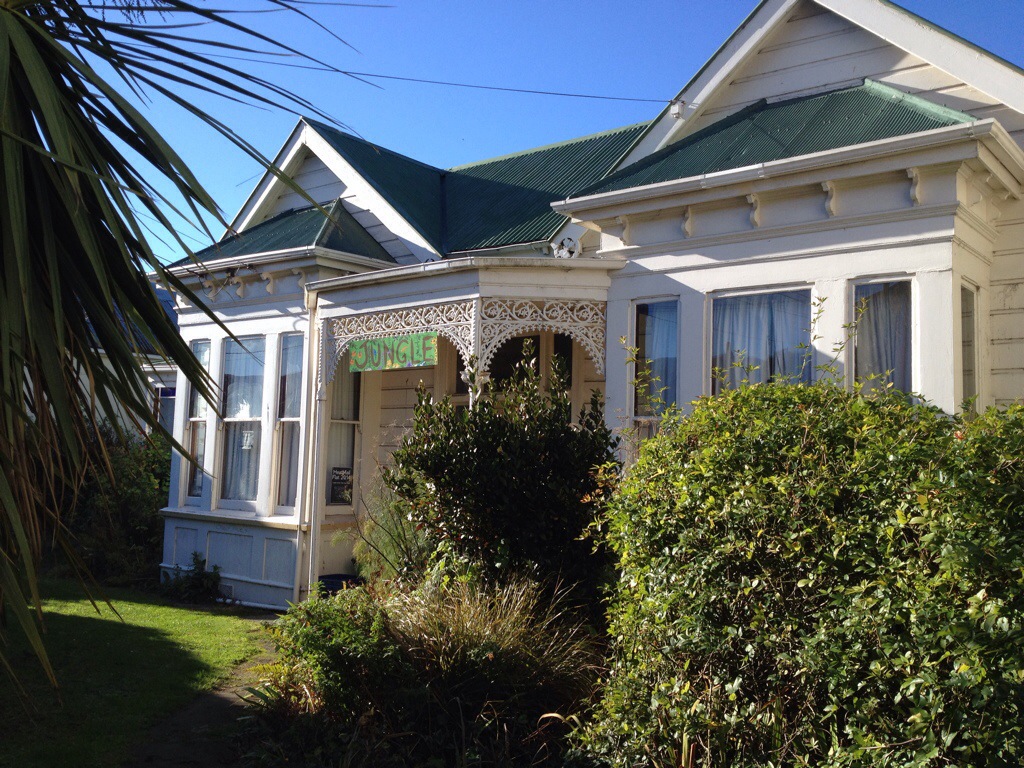
The Jungle on Castle Street
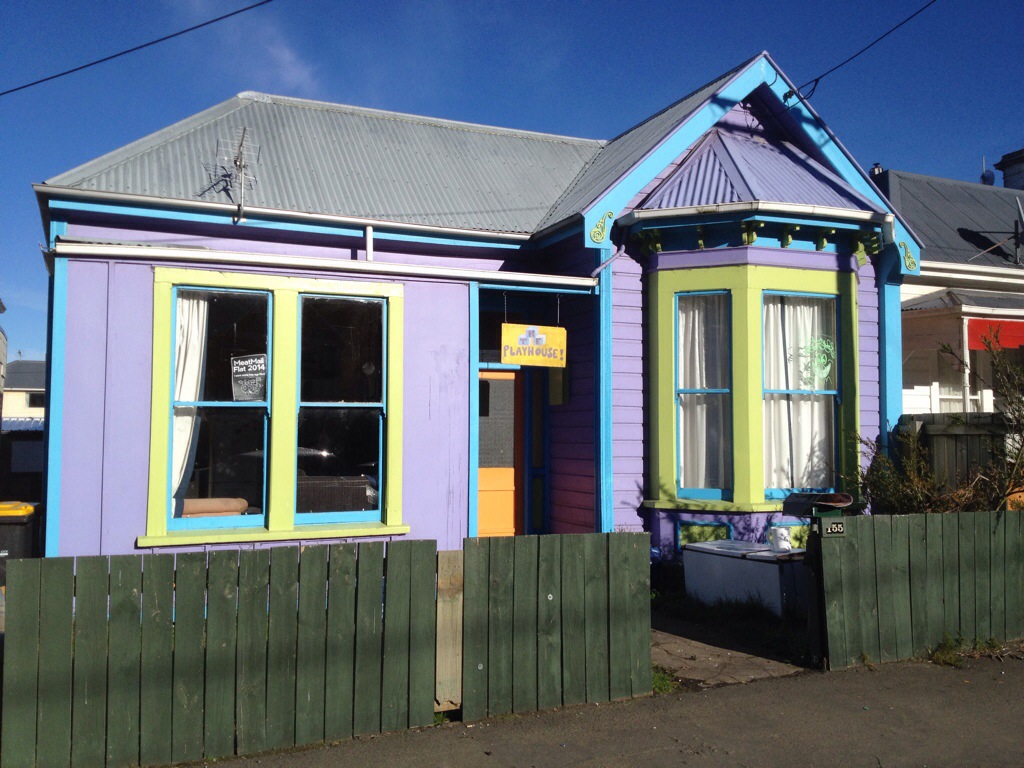
The Playhouse on Dundas St #flatnames
The toga parade that went bad, and the flat name that memorialized it #flatnames
The arrival of students at the beginning of each academic year usually brings a frisson of excitement to the city. At one time a toga parade was established, as OUSA general manager Stephen Alexander (2009) stated in the Otago Daily Times, “so the community and students could meet and greet each other in a colourful way”. This intersection of town and gown met a sticky, smelly, violent end in early 2009.
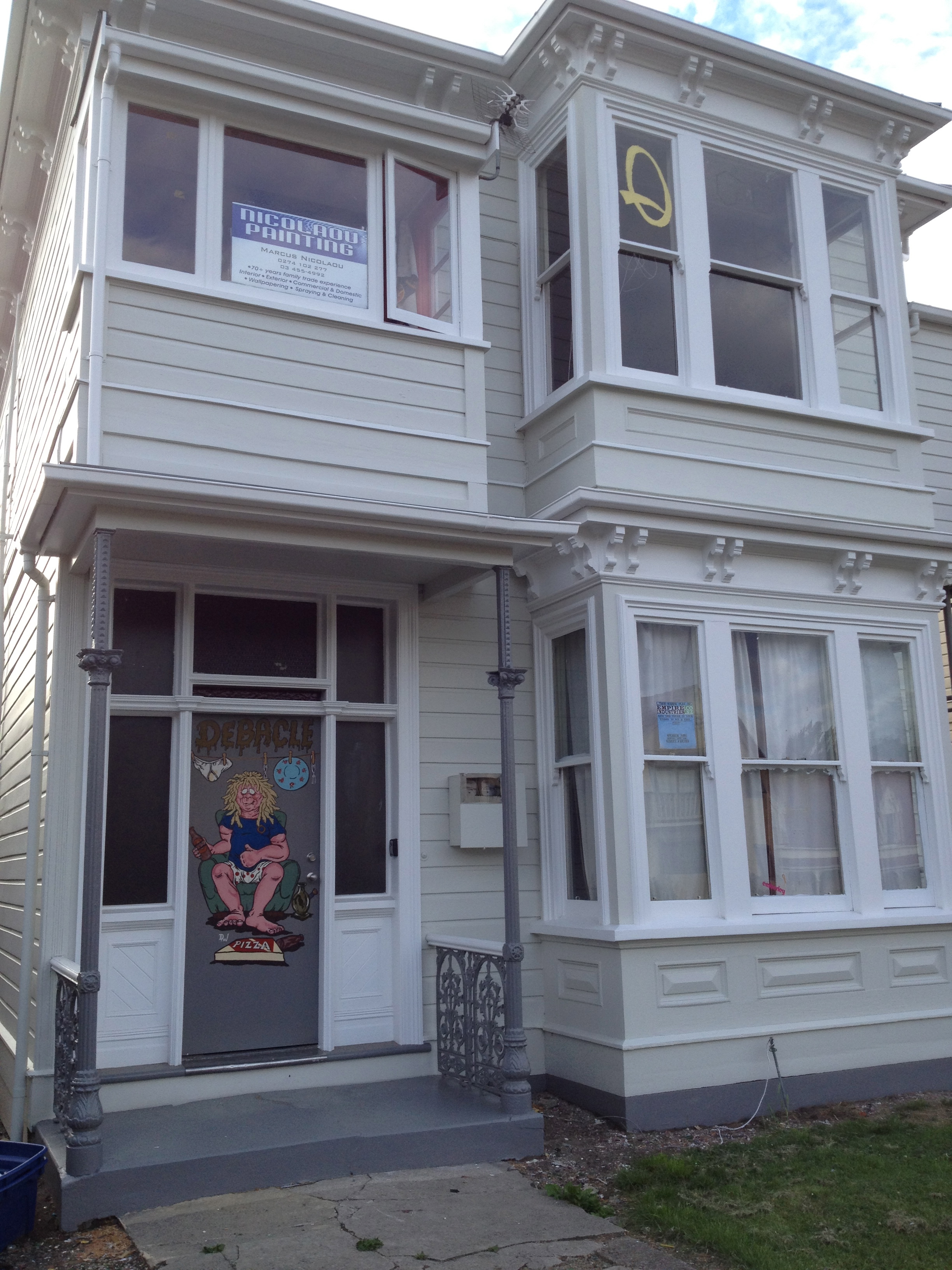
The Debacle (2013)
Wandering down Cumberland Street today, you can clearly see a vividly painted door depicting a student in boxer shorts, seated on a green chair holding a stubbie of beer, and flanked by a bong. In the foreground on the floor sits an unopened pizza box. Above and behind the student’s head hangs a washing line, debecked with y-fronts, a plate, fork and knife. The word Debacle is emblazoned above in what can only be described as a colour and texture reminiscent of fecal matter. It’s the kind of scene some may imagine as a typical student flat. Interestingly, the the story behind the name is quite different.
The OUSA Toga Parade down George Street on the 24th February of that year deteriorated into bedlam which resulted in injury to people and property. The Otago Daily Times (25 February 2009) reported:
“As the large mass of students moved into George St, hundreds of eggs, bottles, rubbish, and buckets full of vomit and faeces, were thrown from first-floor verandas and alleyways, as well as at shop frontages.”
A number of students were disciplined for their involvement. OUSA’s decision to cease future parades was greeted with approval by many people, including retailers and Dunedin police emergency response commander Inspector Alastair Dickie, who said, “after the shamozzle of this year’s parade, we don’t want a repeat …”. An independent report of the event had been undertaken by the former University Proctor, Ron Chambers.
- Photos published by the Otago Daily Times
- Video from the Otago Daily Times (contains explicit language)
- Photos by Varun Thirayan
The end of the day saw some students involved in cleaning up shop frontages, and the end year saw donations from students to the City Council which was passed to Keep Dunedin Beautiful. Mayor Peter Chin was reported as saying, “I think it is an appropriate gesture of appeasement in terms of all the issues that have arisen.”
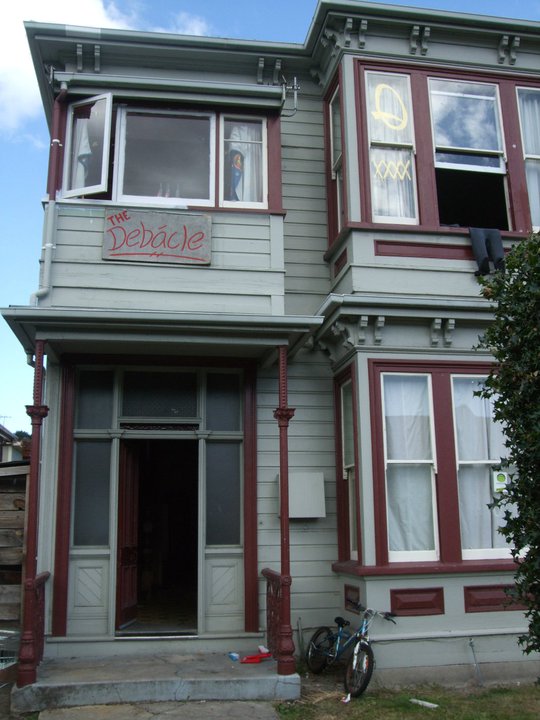
The Debacle (2010)
The event caused deep shock and consternation amongst the public, officials, the University, and naturally amongst some first year students who participated in the parade. The newly appointed Critic editor for 2009, Amy Joseph, let rip in an ODT opinion piece, declaring in no uncertain terms that the behaviour exhibited at the toga parade was not the “Otago way”, and that there should be no plan for reprisals.
“Please listen up and listen well, freshers: this disgusting display is not tradition here at Otago. The eggs, yes, and the flour bombs, sure. But before you start cultivating your own rancid buckets o’ crap for next year’s batch, remember this: those idiot bystanders were trying to hurt you.”
Dunedin City Councillor Dave Cull and Otago University Students Association president Edwin Darlow were interviewed by Mark Sainsbury the following day on new programme, Close Up, and the shock of the event is clearly still with them.
Teige O’Sullivan and Ben Thomson were first years in 2009 and experienced the parade first hand, on the Dunedin Flat Names Facebook page, Ben said, “[We] got pelted with eggs, fruit, human feces and everything in between.” An other first year student commented in the Otago Daily Times,”As one of those first year students who was a participant in this event I was appalled by how violent this annual event was. … During this event I felt like I was being herded like cattle while the other students hurled bottles and things at us.”
In 2010 Teige and Ben took on the lease of Cumberland Street flat with 7 other male students. They renamed it The Debacle, as Teige said, “… to represent the 9 boys that now live in it and the activities which take place within the flat. [The] name originated from this video from a[n] American news report on the toga parades last year.”
About 5 seconds in to the video you can clearly hear the reporter, Ed Donahue (Associated Press), describe the parade as a debacle.
Video source: The Associated Press (25.02.2009).
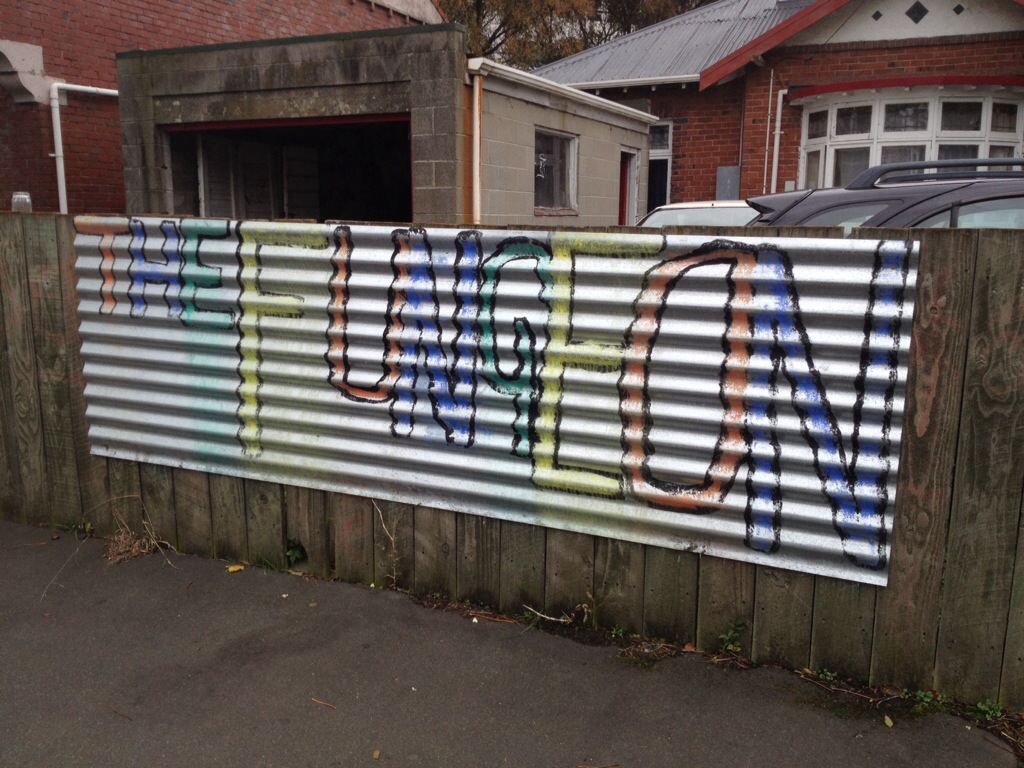
The Fungeon, Emily Seideberg Place #flatnames
A brick bungalow set back from the road with this decorated corrugated iron fence.
Hyde Street Keg Party 2014
So it looks like the Hyde Street party, full of crazy dress ups and named flats, is to be held on the 12 April this year according to OUSA Administrative VP, Ryan Edgar. http://www.critic.co.nz/news/article/3612/the-royal-hyde-street-party
I’m planning a post for early April about the Hyde Street event, so if you have any stories you’d like to share, particularly if you were involved in the early days of the event, please get in touch.
Dr Ali Clarke, historian, blogs about the project
Thanks to Dr Ali Clarke for her wonderful post about the Dunedin Flat Names Project. Ali works at Hocken Collections and is also engaged in writing a history of the University of Otago for the upcoming 150th celebrations. Check out Ali’s posts, she’s covered some fascinating stories. http://otago150years.wordpress.com/2014/03/10/naming-flats/.
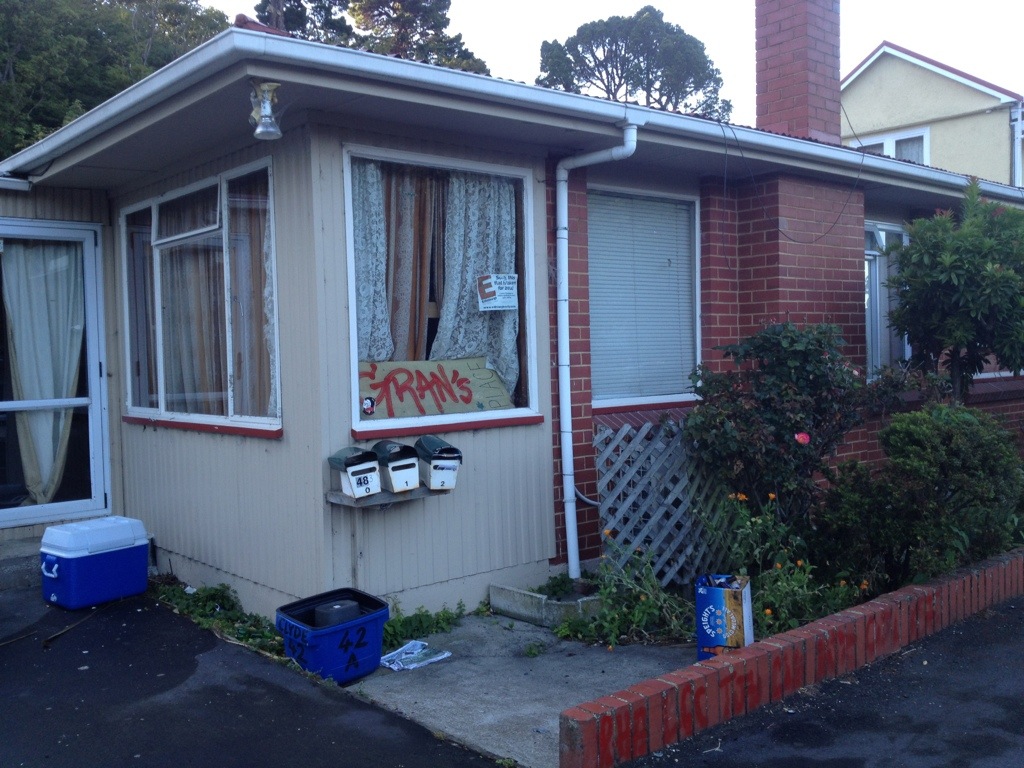
Gran’s Place on Leith St #flatnames
Pic’s Flat – more peanuts than you can poke a stick at #flatnames
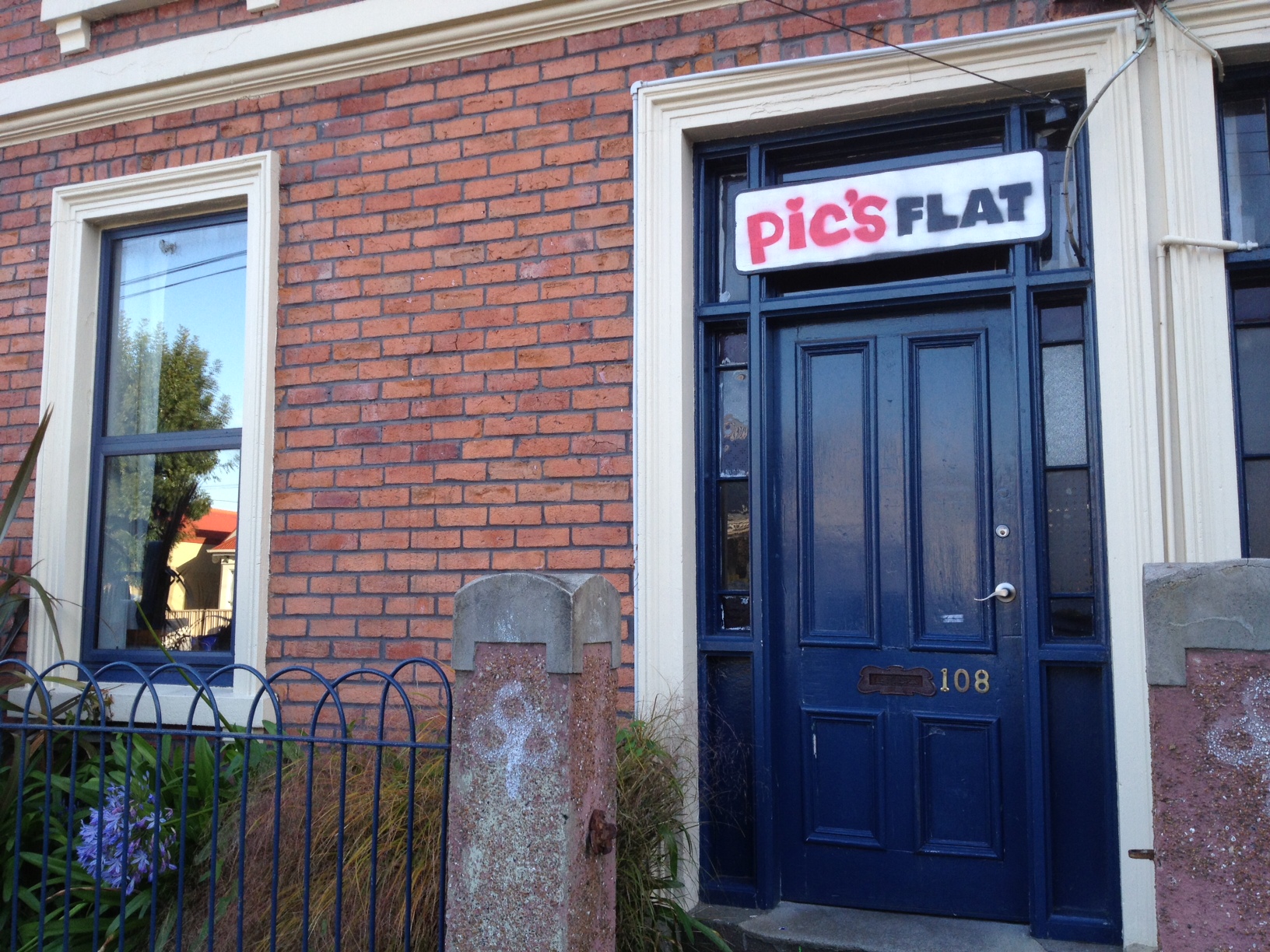
108 Dundas Street (2014)
Pic’s Flat on Dundas Street is a new addition to the named flat community this year and has received it’s name from the (in my opinion) best peanut butter company on the shelves, Pic’s Really Good Peanut Butter.
The five flatmates arranged a 12 months sponsorship deal with Pic’s and now receive a 2.5kg bucket of the peanuty goodness weekly.
Find out more about the flatmates on the Pic’s webpage, and also their Facebook page.
The Embassy #flatnames
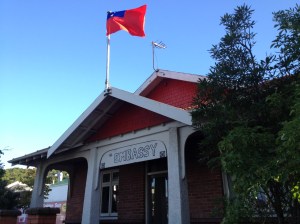
40 Dundas Street (2014)
40 Dundas Street hasn’t been graced by a flat name for more than ten years. It appears we now have a proud Samoan Embassy in Dunedin North!
The last recorded name for this flat was the infamous “Greasy Beaver Lodge”. The (unconfirmed) word on the street was the then landlord banned further naming.
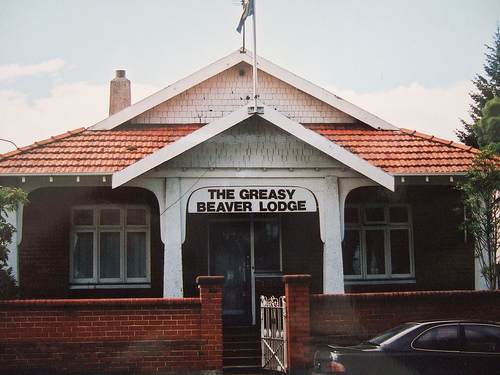
40 Dundas Street (2001)
The Greasy Beaver Lodge will live on in the record of NZ art history however, as it was one of the many named flats in Dunedin that inspired artist, Scott Eady‘s Frances Hodgkins Fellowship in 2002.
A reinterpretation of The Greasy Beaver Lodge sign featured in Scott Eady’s exhibition “Signs” at The Blue Oyster Gallery in 2002. The sign currently resides in the Hocken Collections (record).

The Greasy Beaver Lodge, Scott Eady (2002) at The Blue Oyster Gallery
The Greasy Beaver Lodge reappeared in April 2016 shortly after 40 Dundas Street was sold.
“It was the beginning of everything” 660 Castle Street #flatnames .@six60
Three years ago on a rainy Monday morning in Christchurch, I picked up the phone and called Ji Fraser to interview him about his band Six60, named for their flat at 660 Castle Street. When I asked him about how he found flatting in Dunedin he responded diplomatically, “Flats are not that nice to live in but have heaps of character.” The house and it’s neighbour, were built c 1927-8, and are now looking their age.
Ji hails form Gisbourne but his Otago experience began at University College in 2005, he and Matiu took a couple of music papers – they’d both been turned down for the contemporary rock course. It doesn’t bother them now. They’ve done very well, they signed with Universal Studios on 8 May 2010[1], and their single Rise Up 2.0 recently reached number 1 on the NZ charts on 24th January 2011[2] after entering the charts on 6 Sept 2010.
In 2006 Matiu and Ji moved into 660 Castle Street with friends from University College. They had spent time jamming in their rooms and thought it’d be good to flat together and get a band going. Ji bought a cheap PA. Hoani played the bass. Through the course of the year they met Eli who’s still the current drummer (2011). They referred to the flat amongst themselves, and to others, as 660, and as the band formed and they started playing shows, they became known as the 660 boys. When it came to releasing their first EP, they decided to call themselves Six60, after that Castle Street flat because “it was a place that meant so much to us”.
So, why did this flat mean so much to them. “That’s where it all began”. Ji elaborated, “it’ where I wrote my first song, it’s where we had our first practice together. It was the beginning of everything.” Like so many other Otago alumni, Ji feels the experience flatting has a great impact on students because for many it’s their first time living independently. “They’re really special for a lot of people. So many good times, a lot of bad times too. They’re a rich source of memories.”

Rise Up EP logo via George FM, Copyright Six60.
Before their first NZ tour Ji contacted a friend who has a clothing label called Search. One of their designers came up with a range of ideas for a logo for the band, the brief was to include the name and reference the Castle Street flat. It was used on the Rise Up 2.0 release cover. The guys like the idea of strong visually memorable graphics to advertise themselves.
Their music video for Don’t forget your Roots (directed by Robin Walters, July 2011) cruises through the Dunedin North landscape and highlights a number of named flats of the day.
Six60 are in town for Orientation and took the opportunity to visit 660 Castle St a couple of days ago before playing last night (20.02.14) at the Starters bar (aka The Orie(ntal) or The Last Moa). They play the Forsyth Bar Stadium tonight (21.02.14)
Absolute pleasure meeting the next group of lads to take over the @six60 flat.. It’s gonna be a good week.. pic.twitter.com/dxnvwF78VQ
— Ji fraser SIX60 (@ji_fraser) February 16, 2014
 Dunedin Flat Names Project